
Guest article from skyrocketbpo.com.
Senior living costs range from around $1,700 a month for an age-restricted apartment to more than $10,000 a month for a private nursing home room and the “right” price for your family depends entirely on how much day-to-day help is actually needed.
Housing alone is a different expense than housing plus hands-on care. This guide walks through what each level of senior living costs today. Also how the fee structures differ and what tends to move the price up or down.
Note that “senior living” is a broad umbrella. It spans everything from maintenance-free apartments for active retirees to skilled nursing facilities for people who need round-the-clock medical supervision. The lower end of that range looks a lot like renting a regular apartment, on the other hand the upper end looks more like a hospital stay billed by the month.
Key Takeaways
- Senior apartments and 55+ communities are the least expensive option running close to standard market rent.
- Independent living adds amenities and light services and typically lands between $3,000 and $4,000 a month.
- Assisted living, which includes help with daily activities, has a national median around $6,200 a month, according to CareScout’s 2025 Cost of Care Survey.
- Memory care commands a premium of roughly 15–25% over standard assisted living because of secured units and specialized staffing.
- Nursing homes are the most expensive form of senior living, with a national median above $9,500 a month for a semi-private room.
- Continuing care retirement communities (CCRCs) charge a large upfront entrance fee on top of monthly rent, in exchange for guaranteed access to higher levels of care later.
Senior Apartments and 55+ Communities

Age-restricted apartments — usually requiring residents to be 55 or 62 and older are built with accessibility in mind such as grab bars, walk-in showers and single-floor layouts. Residents handle their own daily routines and simply trade home maintenance for a lease.
The national median rent for a senior apartment is roughly $1,678 a month according to A Place for Mom’s cost research which is close to what a non-age-restricted apartment costs in most markets. Some 55+ communities also sell single-family homes, condos or townhouses rather than renting apartments.
Fee structure:
- Standard month-to-month or annual leases
- A security deposit
- Possibly an HOA fee.
There is generally no large upfront buy-in and optional services like housekeeping are billed separately by third-party vendors.
Independent Living Communities
Independent living is the first tier built specifically around a service-included lifestyle. Residents don’t need help with bathing, dressing or medication. However, they do want meals, transportation, housekeeping and social programming bundled into one price.
Independent living runs a national median of roughly $3,065 to $4,000 a month, according to SeniorLiving.org. This is more than a senior apartment because the rent is covering a hospitality-style service package not just a unit.
Fee structure: Almost always all-inclusive rent covering utilities, maintenance, dining and activities with optional add-ons like premium housekeeping or transportation packages.
Assisted Living
This is where cost jumps significantly because residents are paying for actual caregiving — help with bathing, dressing, medication management, mobility and meals. According to the CareScout Cost of Care Survey, the national median cost of an assisted living community rose 5% year-over-year to $6,200 a month during 2025 or roughly $74,400 annually.
Pricing typically has two layers; a base rate for the apartment and standard amenities and a care fee tied to how much hands-on assistance a resident actually needs. A resident who only needs medication reminders will pay less than one who needs help with several activities of daily living even within the same building.
This industry is currently valued at roughly $42 billion and serves more than 200K care receivers. There are 606,091 establishments nationwide (U.S. Census Bureau, County Business Patterns 2022), the sector shows moderate consolidation—the top five operators control approximately 35% of revenue. Brookdale Senior Living leads with 4.8% market share, followed by Atria (3.7%) and Sunrise (2.8%) (Skyrocketbpo).
Fee structure: Base rent plus tiered care levels often reassessed every few months as needs change. Many communities also charge a one-time community or move-in fee.
Memory Care
Memory care is a secured and specialized form of assisted living for residents with Alzheimer’s disease or another dementia. Staff are trained specifically in dementia care and the building is designed to prevent wandering. Activity programming is structured around cognitive support rather than general socializing.
Memory care costs more than standard assisted living, estimates for the national median cluster between about $6,700 and $8,000 a month with U.S. News putting the premium at roughly 20% above standard assisted living. Many communities also charge a separate community fee, often around $3,000, to cover the additional assessment and onboarding needed when a resident with dementia moves in.
Nursing Homes (Skilled Nursing Facilities)
Nursing homes provide the highest level of medical care outside a hospital with licensed nurses on-site around the clock. They’re intended for residents who need ongoing medical management and not just help with daily living. The pricing reflects that clinical staffing.
According to a CareScout survey, the national median for a semi-private nursing home room reached $9,581 a month in 2025 while a private room ran $10,798 a month which is a 1–3% increase from the year before. These are the most expensive senior living options on a pure monthly basis.
Fee structure: Daily or monthly rate covering room, meals and nursing care. Medicare can cover up to 100 days of a qualifying skilled nursing stay after a hospitalization but it does not pay for long-term custodial nursing home care, a distinction the Medicare.gov site spells out clearly and one families are frequently surprised by.
Continuing Care Retirement Communities (CCRCs)
They bundle independent living, assisted living, memory care and skilled nursing onto one campus so residents can move between levels of care without changing addresses. That convenience comes at the highest total cost of any senior living structure largely because of the entrance fee.
Entrance fees vary enormously by contract type and region but industry research from the National Investment Center for Seniors Housing & Care (NIC) has placed the average well into the hundreds of thousands of dollars on top of an ongoing monthly service fee. Some of that entrance fee may be refundable to a resident’s estate depending on the contract and some CCRCs now offer a no-entrance-fee model with a higher monthly rate instead.
Fee structure: Large one-time entrance fee (partially refundable in many contracts) plus a monthly service fee that can rise as a resident moves into higher levels of care.
What Actually Moves the Price
A few factors explain most of the variation you’ll see between two communities offering the “same” level of care:
- Location. Coastal metros and high-cost-of-living states routinely run double the price of the least expensive states.
- Level of care. Within assisted living and memory care especially, the care-level fee can add hundreds or thousands of dollars on top of base rent.
- Room type. A private room or apartment costs meaningfully more than a shared or semi-private one most visibly in nursing homes.
- Amenities and building age. Newer buildings with resort-style amenities charge accordingly; older or smaller communities are often cheaper.
How Families Typically Pay for It
Most families draw from a mix of sources rather than one single payer:
- Private savings and retirement income cover the bulk of independent and assisted living costs for most residents.
- Long-term care insurance
- Medicare covers short-term skilled nursing after a qualifying hospital stay and some home health visits but not ongoing assisted living rent or custodial care which is a common point of confusion worth confirming directly on Medicare.gov.
- Medicaid can help cover nursing home costs for residents who qualify financially, and some states extend limited assisted living support through waiver programs.
- VA Aid and Attendance benefits can help eligible veterans and surviving spouses offset the cost of assisted living or in-home care.
Key Stats
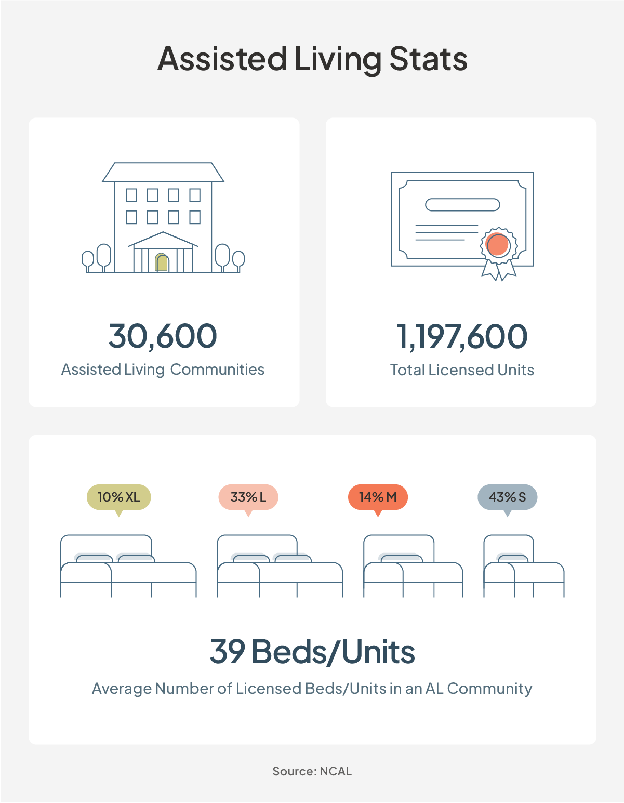
- Approximately 30,600 assisted living communities exist in the United States (NCAL).
- Over 9.5 million seniors in the U.S. live, for some period, in long-term care and post-acute care facilities each year (CDC).
- Over 81 percent of residential care communities are for-profit organizations (CDC).
- The national average cost of nursing home care in 2023 is $8,390 per month for a semi-private room and $9,584 per month for a private room.
- 41.3 percent of residents of assisted living facilities have Alzheimer’s or dementia.
Finding the Right Fit for Your Budget
Because pricing varies so much by care type, region and individual need; the most useful first step is usually a local comparison rather than relying on national averages alone. Many families start with a licensed senior living advisor, a local Area Agency on Aging or an elder law attorney who can walk through Medicaid planning if long-term nursing home costs are a concern.